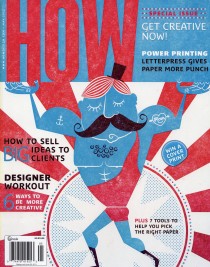
Look in the mirror and say hello to the nightmare of all clients—Yourself. Why is it so hard for graphic designers to design for ourselves? In my latest article for HOW Magazine, I offer tips for taming the fire-breathing client within yourself while working on your brand’s website and other promotional materials. Read the full article HERE.

Design Writing: The Nightmare Client—YOU (or rather…me!)
July 16th, 2010 § 2
Selecting a San Francisco graphic design firm: How our design clients find and choose us
February 22nd, 2010 § 0
Preface: This article offers tips and advice for both graphic design firms and the businesses seeking to hire them. Although the focus is on San Francisco graphic design firms (a city bursting at the seams with a slew of graphic design firms and freelance designers), the contents are universal and beneficial to all geographic locations.
In my previous article, How to get graphic design and copywriting clients, I interviewed three top creative firms and asked them all the nitty-gritty details on how to generate new business. Then I got to thinking…how great would it be to have just a few minutes of the clients’ time to pick their brains on how they find and choose us?
Choosing a graphic design firm can be a daunting process. Offering fantastic first-hand perspective on the process are: Marco Zappacosta, co-founder and CEO of Thumbtack an online marketplace for local services; Lauren Schiller, co-founder of the weekly San Francisco radio show, Lady Brain; and Tex Dworkin, Director of Social Media for Global Exchange. Moderated by San Francisco graphic designer / writer, Stephanie Orma of Orma Design and She’s SO Creative, the three share their experience, advice, fears, and turns-off in selecting a design firm. This is an honest, eye-opening discussion that every designer-seeking-client must read.
1. In a nutshell, please describe your business.
Zappacosta: Thumbtack is an online marketplace for local services (think eBay for services).
Schiller: Lady Brain is the most candid advice show on San Francisco radio. My partner Steph and I cover topics so personal, you may have thought they could only happen to you. We air on KUSF 90.3 FM. Our weekly show is also available through iTunes and on our website, askladybrain.com.
Dworkin: I sit on the board of the Fair Trade Resource Network and Fair Trade Federation Fundraising committee. These organizations are networks/resources for Fair Trade, socially responsible businesses in the U.S.
2. Why were you in need of a designer?
Zappacosta: When we started Thumbtack, we didn’t have any design capabilities in-house, but knew it would be key to building a good service. So we decided to hire an outside firm.
Schiller: When we first launched the show, we knew we needed to grow our online presence to support podcast downloads and get the word out to ladies everywhere about Lady Brain. We have ablog and Facebook page, but needed a home for our brand online. We also wanted to represent ourselves as a legitimate broadcasting presence, not just another podcast.
Dworkin: We were seeking a designer to design a new calendar that would be sold in retail stores as a fundraising tool for our organization.
3. How did you go about finding a designer?
Zappacosta: We set about the search mainly by mining blog posts and lists of “best SF designers.” We didn’t post any Craigslist ads because we’d heard of people getting inundated with crap. After creating a list of potential candidates, we did a deep dive into their portfolios to identify whether we liked their style and whether they’d ever attempted a project like ours.
Schiller: Because I have a background in marketing and advertising, I knew of a handful of good design firms in the city that I had worked with in the past, or came recommended. I reached out to my network for recommendations and met with the designers whose aesthetic I shared.
Dworkin: I used Google in combination with design firms I already knew about, as well as advice from co-workers. Once I had a list of possible firms, I emailed each one individually. I then spoke on the phone with the leading contenders to explain the project and get a feel for whether they would be a good fit for the project.
4. Was the search to find a designer difficult?
Zappacosta: Yes! In the end, I feel like we got lucky. First, it’s hard to know what’s out there. Second, it’s hard to evaluate what you’re seeing. And finally, it’s hard to get into contact with everyone (we didn’t hear back from all the designers we contacted).
Schiller: Because of my past experience in the industry, I was able to find a number of qualified designers and agencies relatively quickly. Although there are many talented designers, the more difficult task is finding the right agency: one that can meet your time frame, budget, quality standards, and understand your audience and the role of your website – and can present a creative vision.
Dworkin: It was time consuming. It was very important to find the right design firm to do this project, one that was values-based and would be able to address the tastes of our target audience. I was surprised that one firm that came highly recommended actually took weeks to get me a quote, as well as the info they said they would send. It really turned me off and I did not go with them for obvious reasons.
5. How many responses did you get/have options to choose from?
Zappacosta: In the end we had 4 phone calls and 3 in person meetings.
Schiller: Because I narrowed the list down first, I took bids from a few agencies and met with each to discuss their capabilities and credentials.
Dworkin: From those I contacted, the majority responded, although in some cases, surprisingly not very fast. The speed at which they responded definitely affected my decision. I finally narrowed it down to 3 firms and made my final decision after seeing a sample of a very similar project to mine in the winning firm’s portfolio.
6. When you looked at the designers’ portfolios, what exactly were you looking for? And was it hard to assess if they would be a good fit for you?
Zappacosta: Because of what we were trying to build we went looking for designers that had built interactive websites. It’s one thing to create a good-looking design but another to create an intuitive one. The hardest part about evaluating designers’ work is trying to figure out exactly what they did. Often, and especially if the project they did was big, there were collaborators and/or other consultants, making it hard to identify exactly what the designer in question brought to the table.
Schiller: It’s important for the agency to understand whom they’re building a site for. Having a great design sense is only the beginning – if the website doesn’t speak to its audience, it doesn’t serve its purpose. So in looking at portfolios, I tried to understand the nature of each business and assess how the final site spoke to their audience and communicated their message and whether they’d be able to provide a customized experience.
Dworkin: I immediately looked for similar projects and quality. Seeing samples in person made it very easy to determine which would and wouldn’t be a good fit for my project.
7. What were the most important factors in choosing a graphic design firm?
Zappacosta: The most important factor for us was a firm that could take us through the entire process of conceptualization, mock-ups, design, and coding. We really needed all of it from one group.
Schiller: Cost was definitely an issue – we didn’t have a big budget. But having someone who understood our concept and was able to not only design something we liked, but come up with new, fresh ideas for presenting our brand online was key.
Dworkin: In order of priority, the deciding factors were: cost, quality, similar project, and speed of response.
8. What were your biggest fears in hiring a graphic design firm?
Zappacosta: The biggest fear is thinking that you’ll get too far along in the process before you realize you’ve hired the wrong person. The designer ultimately controls how your clients or customers see your product – it’s a huge responsibility.
Schiller: You never know what the final product is going to look like. So I think the biggest fear is always “Will I get what I paid for?” and “Will it work to accomplish my goals?” “Will I like it?”
Dworkin: Our biggest concern was that our deadlines would be met. With this project being a calendar, we really needed to stick to our timeline.
9. Were you happy with the outcome? Anything you would have done differently?
Zappacosta: We selected Project6 Design and were quite happy with what we got:www.thumbtack.com One thing we didn’t quite handle correctly was how to deal with post-project edits and improvements. Being a start-up, we’re constantly changing, and I think we could have been clearer from the get-go how this phase of the relationship would go.
Schiller: We love our site designed by Veneer Studio. With the move to broadcast radio from strictly podcasting and the combination of social media and grassroots growth, it’s doing a great job supporting Lady Brain. They definitely got our sense of humor and kept it simple.
Dworkin: We were happy with the calendar (not shown) that Design Action Collective, created for us. Looking back, I would have allowed more time in our own timeline for the entire design process. You can only do so much to move the timeline forward on your end.
(originally appeared in SF Examiner 02/22/10)
San Francisco turns vacant storefronts into inspiring works of art
January 13th, 2010 § 0
You’re in a fabulous mood, the weather is gorgeous, the sun is shining but as you stroll down any U.S. city street not even the Prozac-free among us can avoid the depressing vision of vacant storefronts; a constant reminder of one of the ugliest economic times in our nation’s history. So what’s a city to do?

The San Francisco Art in Storefronts project (an effort by The San Francisco Arts Commission, in collaboration with the Mayor’s office of Economic and Workforce Development and Triple Base Gallery) will launch a unique initiative on October 23rd to revitalize local neighborhoods hardest hit by the economic downturn. At this inaugural event, San Francisco-based artists and designers will temporarily place original art installations into 10 vacant storefront windows transforming them into inspiring works of art.
Among the initial storefronts to be unveiled is a thought-provoking piece by the San Francisco design firm MINE™. In a darkened storefront a neon sign proclaiming, “Everything is OK” will hover above rows of canned “products” that promise instant “OK-ness.” According to Mine’s founder and creative director Christopher Simmons, “The installation is designed as a provocation through which passersby are challenged to explore their relationship to the status quo and the term ‘OK.’ Does ‘OK’ signify ‘good’ or merely mediocre? If everything is mediocre, is that what we’re being asked to accept?”
This installation could not be more appropriate as the world sits with bated breath wondering, “Is the economy improving? Is everything OK?” With innovative economic revitalization efforts like this one, I don’t know about you, but my little black Magic 8-Ball reads “outlook good.” So let’s go shopping…window-shopping that is! And hey, more good news, it won’t cost a dime.
WHEN:
Friday, October 23, 2009, 5-7PM
Formal Remarks at 5:30, followed by an unveiling of the the window installations, live music, and an art walk with the artists.
WHERE:
Storefronts located along Market Street between 5th and 8th Streets.
Reception and remarks at 989 Market Street at 6th Street
(originally appeared in SF Examiner 9/23/09)
San Francisco designers, artists, cyclists: ARTCRANK headed to Bay Area for Bike Poster Art Show
January 13th, 2010 § 0
If you’re an entrepreneur (or ever had daydreams during death-by-boredom conference meetings of becoming one) you’re familiar with the process of trying to come up with “the big idea.” It ain’t easy, to say the least: researching, brainstorming, sleepless nights, feeling like your banging your head against a brick wall, headaches (from actually banging your head against a brick wall), more sleepless nights (from uncomfortable bandages wrapped around now bruised head). Then, finally, at 4:23am as you lay in bed ready to strangle the 1,099th sheep you’ve counted – the idea finally comes!

Understanding this crazy, difficult process, I’m ever more appreciative of creative, original, inspired new business and product ideas. Thus, the moment I heard about ARTCRANK, the bike-themed poster art show (coming to San Francisco on October 24 at 580 4th Street), I had to know – who the heck thought of such a brilliantly simple concept of combining bikes and art??
Now before you go banging your head against a wall (again) in a “why didn’t I think of that” frenzy, check out this insightful interview with the clever brains behind ARTCRANK, Director/Curator Charles Youel. And then go check out an art show like you have never experienced before. READ FULL ARTICLE: SF EXAMINER
The art of people watching: Or the silly, bobble-headed human guide to creative inspiration
January 13th, 2010 § 0
Growing-up, I had a friend whose Mom took her to the zoo quite often. But rather than looking at the actual animals, the Mom was way more into the people watching. Just picture it: the little girl pulling on Mommy’s sleeve begging to see the zebras while Mommy whispers, “I’ll show you stripes. Take a gander at the woman behind you in that god-awful, skunky-striped outfit! What was she thinking!”

People watching can be a great source of amusement, especially when observing those with bad taste. It can also be a well-spring of inspiration.
For example, I was recently stuck in the airport during an unusually long flight delay. Rather than getting my panties in a bunch (like most of my fellow passengers…), I became enthralled with the people watching. For the entire three hours my buttocks was planted on those uncomfortable, orange terminal chairs, I had a blast doodling airport folks, creating caricatures, and thinking about them in whacky “what if” scenarios. From the stressed out guy on his cell phone to the young Carly Simon look-alike to the funny-looking dude slumped in his own uncomfortable orange chair, I came up with nearly a dozen new concepts for my clever card line, She’s SO Creative. Now that’s time well-spent in my book!
But more than just for “artsy types” people watching can be just as valuable for entrepreneurs, marketers, and business people alike. Seeking the next great product idea in the gazillion dollar pet industry? Just observe pet owners in any situation – they’re a tad, well…weird. But weird is good! (Flattery helps their egos). For starters, when it rains watch how the funny human-types hover their umbrella over little Fido so he doesn’t get wet, while they themselves get drenched from head-to-toe in the process. Now there’s got to be a better way – and BAM! You’ve got yourself the first-ever “Dog-Gone Rainy Day Umbrella Kit”. Sure it’s a kooky idea, but that train of unconventional thinking will no doubt lead to innovative ideas.
Thus, there’s more to people watching than just “the watching.” The real “art” is in the observing andthe thinking, brainstorming, etc. In essence, creativity is about looking and thinking about things from a fresh, new perspective. And what better way to turn the ordinary on its head than by observing human beings from an objective distance rather than our conventional mode of interaction. And by “conventional” I mean “talking to one another in person” (for all you emailing, text-messaging, Twittering, FaceBooking and/or socially awkward types).
So the next time you’re seeking creative inspiration or on the hunt for the next big idea, pull-up a seat on an old park bench. But instead of watching the pigeons bobble their tiny feather-heads, focus on us silly, bobble-headed humans. And let your imagination fly!
(originally appeared in SF Examiner 8/26/09)
Crank up your design radar
January 13th, 2010 § 0
No one understands the statement, “design is everywhere” better than us designers. But comprehension and integration are two totally separate acts. From food packaging, to billboards, to book covers, catalogs, websites, and everything in between, we spend the majority of our waking hours on our computers designing and/or looking at these designs through the portals of our monitors.But when the computer is shut down, does your “design radar” go off-line, as well?
For instance, when it’s time to grocery shop, are you in the get-in/get-out as fast as possible mindset? Or do you treat the experience as a journey through Design Mecca – with sources of inspiration lining the shelves from wall to wall? When you’re waiting on the unbearably slow line at the post office do you temper your impatience by burying your nose in your iPhone? Or do you make note of the ugly signage covering the walls and kill the time by redesigning it better in your head? “Cranking up your design radar” is about never turning off the designer in ourselves. READ FULL ARTICLE: Smashing Magazine
The most creative people in our world today: American Entrepreneurs
January 13th, 2010 § 0
Despite the economic slow down, the creative, innovative thinking of today’s entrepreneurs is still going full steam ahead. In every industry from technology to music to books to crafts, today’s entrepreneurs are coming out with the most inspired new products, new ventures, and pursuing their dreams. Rather than focusing on stock market investments, these creative entrepreneurs are investing in themselves.

Above: Clever "Salad Dressing" greeting card from my own innovative start-up, She's SO Creative. Photo Courtesy, Stephanie Orma / She's SO Creative
Ankesh Kumar, an entrepreneur from Palo Alto, CA has come up with the next big idea in social media. He’s the creative genius behind the start-up,Grouptivity, a Web 2.0 sharing network that enables web publishers to keep track of what content their users are sharing via email, as well as all the social media sites. Hearst, Chronicle and other big players in the web publishing industry have already signed on to use Grouptivity’s exciting new application.
Marin Magazine, a thriving start-up in its own right, came up with the original idea to produce the cookbook, Organic Marin, a celebration of Marin County farmers, artisans, and cooks.
Teresa Joy of Reidsville, NC, just this past month launched Doxie Crafts, one of the first ecommerce sites providing unique American hand-made dachshund only crafts from artisans all across the country.
And after being the first in her doctorate psychology program to complete her dissertation, new mom Karly Kaplan was innovative enough to see how her thorough understanding of the dissertation mental process could be of real service to others. Thus, she launched the San Francisco-based start-up, My Dissertation Coach.
So how have these folks been able to forge ahead despite the “sky is falling” mentality that we’re constantly bombarded with on daily basis?
According to one entrepreneur, Alymar Eugenio, who launched the Napa, CA start-up recording studio, Backstage Recording and the band Eye Eighty, “as an artist, recording engineer, business owner…what drives me is my love for music and the whole creative process, being involved with other musicians and having a final product to share with the world. There is no other feeling like it…”
The media presents us with a world full of doom and gloom on a daily basis and we can choose to either get sucked into it or we can put our attention on our dreams and forge ahead. And that’s exactly what the American Entrepreneurs of today are doing. They’re not letting the economy stop them. With nothing but their brilliant, creative ideas and the drive and determination to see them come to fruition, they’re moving forward and in the process, moving our world forward too. Frankly, I can’t think of anything more inspiring or exciting.
(originally appeared in SF Examiner 3/30/09)
Are you a closet creative? The secret creative life of not-so-ordinary professional folks
January 13th, 2010 § 0
Closet Creatives” – they’re hiding everywhere: the endocrinologist who makes exquisite crafts when she’s not diagnosing patients; the banker who plays foot-stomping, spirit-lifting trombone music when he’s not handling mergers and acquisitions; the pharmacist who writes lyrically, beautiful poetry when she’s not dispensing pills.

There’s a tremendous amount of hidden talent behind the professional folks we encounter every single day of our lives. While I was working at a marketing firm, it was nearly a year before the account manager sitting in the cubicle right next to mine disclosed that she was a photographer and painter. But she was more than just a hobbyist. She had a professional website oozing with a plethora of gorgeous, gallery-quality art.
So why on Earth would these immensely talented folks keep their creative endeavors on the down-low?
Non-profit grant writer and Closet Creative cartoonist,Scott Metzger, helped shed some light on the subject, “Up until a few months ago, no one at my work knew about my side gig. I had this concern that if they found out, they might not think I was serious about my job or something. Turns out one of our Board members lives in Mill Valley and shops at Two Neat. She mailed me one of my own greeting cards and wrote ‘I’m on to you!’ But she loves the cards, so it’s cool.”
Well, I’m encouraging all Closest Creatives to come out of the closet today! Your work inspires us and brightens our lives, and god knows we could all use a good dose of that in our world today. To get started, here’s a few folks who I think are extraordinary:
Emily Singer
Day job: Political speechwriter
Closet Creative job: Film writer, director, editor
http://www.imdb.com/name/nm0801925/
Sonali Shah
Day job: Marketing account manager
Closet Creative job: Painter, photographer, creative writer
http://www.studiosonali.com
Scott Metzger
Day job: Grant writer for non-profit
Closet Creative job: Cartoonist
http://www.metzgercartoons.com
Audrey Welch
Day job: Corporate art director
Closet Creative job: Painter, artist
http://www.audreywelch.com/
Are you a Closet Creative too? Want to be added to our list? Fill out the comment box below with your name, day job, Closet Creative job, and a link to your creative pursuits. Thanks for sharing and enriching our lives!
(originally appeared in SF Examiner 3/18/09)