May 26th, 2011 Comments Off
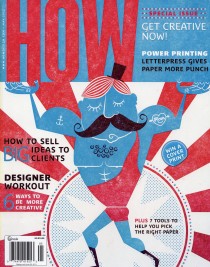
I recently spoke with an extremely talented graphic designer who was struggling with a book cover design. She confided, “I’m starting to feel like I suck as a designer because I can’t figure out a solution to this problem.”
“Oh, thank god!” I exclaimed.
She was a bit baffled (and slightly ticked off) at my response until I explained that I literally thought I was the only graphic designer who felt this way. Hours after hours of trying this idea and that idea and still not coming up with a feasible solution feels…well – pretty darn crappy. But now that the, “yeah, I’m not alone!” party is over, the question remains: how exactly do we get rid of this negative self-talk? For help on this matter, I went to the top – the very top: Chip Kidd, Paula Scher, Stefan Sagmeister, and Robynne Raye – to be precise.
Read my full article below or buy the awesome May 2011 HOW MAGAZINE.


January 13th, 2010 Comments Off
If you missed Live From the Left Coast’s radio discussion on typography this past Friday, October 30th, you can still catch the lively, informative, and humorous discussion via their Podcast. Host Angie Coiro discusses typography and its impact on our daily lives with Tom Ingalls, founder of Ingalls Design and Professor of Graphic Design at the California College for the Arts, Dave and Holly Combs, of PEEL Magazine and creators of the movement to Ban Comic Sans, and myself, designer/writer Stephanie Orma of Orma Design and She’s SO Creative.
Would love to hear your comments and thoughts on the typography show.

January 13th, 2010 Comments Off
Most folks are familiar with the old proverb, “Those who can, do. Those who can’t, teach.” Well, Leslie Becker (designer, writer, scholar, professor, and recipient of the AIGA SF 2009 Fellow Award) is one giant exception to that rule. This extraordinary California College of the Arts (CCA) design educator has accomplished more in her lifetime, than most people dream of achieving in their entire lives.
Her professional bio is available online.
But if you’re craving to go beyond just the surface, (as Leslie has throughout her remarkable career), then follow interviewer/designer Stephanie Orma as she digs deeper, goes beneath the surface and discovers what it takes to follow your dreams. With a career built on talent, determination, hard work, and driving curiosity, Leslie Becker shares her personal thoughts, experiences, and reflections on her life in design, thus far.
Orma: With such a successful career working on projects ranging from graphic design, interior design, custom furniture, writing and teaching to completing a second degree and a Ph.D., plus running a marathon (at the age of 50 to boot!) what achievement are you most proud of? And why?
Leslie: Although I needed to complete a marathon because “it was there,” I couldn’t imagine going to my grave without having done one. I know this makes no sense, but I come from a competitive family. I might say that having finished my Ph.D. is what I am most proud of, but this is probably because it is the most recent achievement and definitely was a kind of boot camp that lasted for 5.5 years! I am also delighted to receive communications from former students who thank me years after having been in my class for something I imparted to them. Personally, I am most proud of my two sons because I find them to be good people. They have been living their lives according to values that I respect. (I realize that this is immensely self-congratulatory.)
Orma: In terms of your career and all the eclectic projects you’ve worked on over the years, can you pinpoint one or two that really stand out as favorites?
Leslie: I really enjoyed a lighting project that I did many years ago. It was extremely experimental and, though I wasn’t conscious of it at the time, was actually based upon the form of a military parafoil kite. Years later, I realized that I had just finished a kite catalog when I began the lighting project. This particular client would look at a rough sketch and enthusiastically encourage me to have it made. I would then go back to the office and deal with the space between fantastical idea and fabrication.
Another significant project was the Wooden Synagogue project. It was a series of print pieces designed to raise funds to rebuild a replica in Berkeley of a wooden synagogue that had been destroyed by the Nazis. Even the discussions around my choice of Fraktur [typeface] were really emotional. To read the complete interview, as well as interviews with Doug Akagi and Michael Cronan (equally exceptional 2009 Fellow Award recipients) visit AIGA SF
January 13th, 2010 Comments Off
I have a love/hate relationship with typography. Love in the sense that I am so passionate about the craft, I’ll stay up night upon night tweaking the type in a design so it’s just right. Hours will fly by, darkness will turn to dawn, but I won’t have cared or noticed because the type is all I see. Love in the sense that when I spot gorgeous typography, I simply cannot stop staring at the awe inspiring, drool-worthy brilliance. But typography is also my chief nemesis. It’s not a skill that comes naturally to me. And some days it feels like a constant uphill battle. It’s frustrating, it’s maddening, and probably even more so because of my fervent passion for the craft.
Typography is arguably the single most challenging element in graphic design to master, and likewise, the most crucial. The designers I have interviewed today are champions of typography and frankly, my personal design heroes. Their mastery of working with type is nothing short of downright enviable: Aya Akazawa, senior designer of Chronicle Books and sole designer of Souffle by Le Petit Graphiste; Todd Hedgpeth principal and creative director of Tawd Design and graphic design instructor at Academy of Art University; John Barretto art director and senior designer of Tolleson Design; Max Spector, art director and senior design of Chen Design; and Josh Chen, principal and creative director of Chen Design. Moderated by San Francisco graphic designer and copywriter Stephanie Orma of Orma Design and She’s SO Creative, the five acclaimed designers talk good type / bad type and share insightful tips for newbie designers to seasoned professional alike seeking to master the art of typography.

READ FULL ARTICLE: SF EXAMINER
January 13th, 2010 Comments Off
With the economy run amuck, there’s a huge imbalance of job-seeking graphic designers to available graphic design jobs. Thus, hiring firms are in the incredibly challenging position of sifting through a plethora of prospective talent. Add to the fact that the San Francisco graphic design scene is bursting at the seams with a slew of graphic design firms, freelance graphic designers, and two top tier graphic design schools, California College of the Arts and the Academy of Art University, the challenge to choose the right candidate can be downright overwhelming for San Francisco businesses.

To help facilitate the screening process, here are 2 crucial must-have skills to look for when reviewing designers’ portfolios:
- TYPOGRAPHY
Typography (selecting typefaces and arranging them on the page) is the hardest skill for a graphic designer to master. It’s literally what separates the men from the boys (or the good designers from the so-so ones). Typography can make or break a design piece – it’s that crucial. But choose a candidate with a solid grasp of how to work and communicate with type, and your business will reap the rewards all the way down to the bottom line.
- CONCEPTUAL SKILLS
There are three types of designers: (1) the ones that make things look pretty, but are not idea generators, (2) the ones that have great ideas but can’t execute, and (3) the ones that are equally adept at both aesthetics and conceptual thinking. Any candidate that has the ability to generate and execute solid, fresh, creative, relevant ideas will be invaluable to your company. Why? Because you’re getting more than just a designer, you’re getting visionary who can help take your business to the next level. And that’s priceless…or at the least, well-worth the designer’s fees.
(originally appeared in SF Examiner 3/19/09)